What the sentence about an antibody leaves out
An antibody is Y-shaped, with two arms that bind and a stem that signals. Every word of that is true, and the molecule is 69 Å thick in the direction the drawing throws away.
Anyone who has taken an immunology course can draw an antibody. A Y. Two arms that grip whatever the antibody is against, one stem that tells the rest of the immune system what to do about it. The sentence is true, the drawing is useful, and between them they have taught the shape to everybody who knows it.
They also agree with each other rather than with the molecule. One intact antibody has been sitting in the Protein Data Bank since 1997, deposited by Harris and colleagues at 2.8 Å, free for anyone to download. It is possible simply to measure it.
-
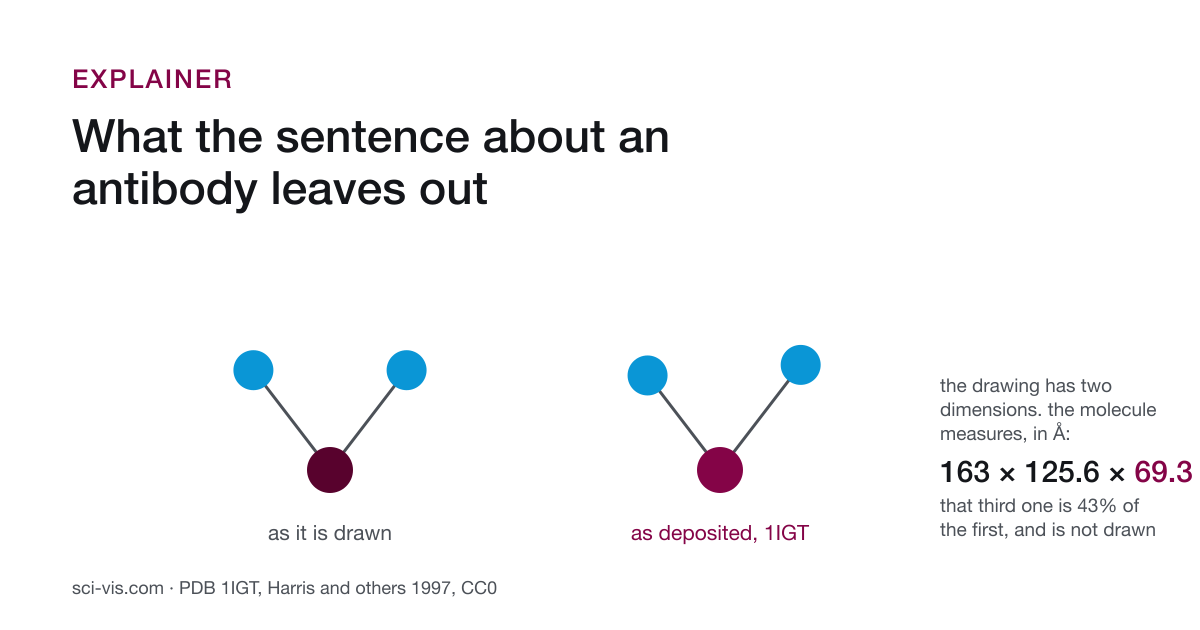
This is the antibody everyone draws: two arms of the same length, placed symmetrically about the stem. It is the picture that goes with the sentence, and the sentence does not contradict it.
A symmetrical Y, both arms the same length from the stem.
-
This is where the three lobes actually sit in the deposited structure, to the same scale. The arms are 75 degrees apart, and they do not straddle the stem evenly.
The arms move to their measured positions, 75 degrees apart and no longer mirrored.
-
The two arms are not the same distance from the stem either: 80.3 Å on one side and 72.2 Å on the other. The whole molecule spans 16.3 nm.
Each arm is labelled with its measured distance from the stem.
-
And it is sugared. The structure holds 18 sugar residues, 220 atoms in all, and every one of them is on the stem. None is on the arms.
The stem is recoloured to mark it as the site of all the sugar in the structure.
The drawn antibody and the measured one
Centres of mass of the three lobes, to scale, in the plane the three of them define. The lobes are found by clustering the deposited atom positions, not by cutting the chain at a residue number: the split is confirmed by the stem containing 0 of 3294 light-chain atoms, light chains occurring only in the arms.
Three numbers, none of which a sentence carries well. The arms sit 75 degrees apart. They are 80.3 and 72.2 Å from the stem, which is a difference of about a tenth. And all 220 sugar atoms in the structure are on the stem, with none on the arms.
That last one is not decoration. It is most of what distinguishes this part of the molecule from a drawing of it, and a Y with two arms and a stem has nowhere to put it.
Which raises the question the drawing cannot be asked. A Y on a page has two dimensions. How many does the molecule use?
The honest difficulty, which is also the point
A crystal structure is one molecule, held still, in one pose. The joint between the arms and the stem is flexible, which is the whole reason an antibody can grip two things at once that are not conveniently spaced. So 75 degrees is what this molecule was doing in this crystal. It is not the angle of antibodies, and anybody quoting it as one would be doing with a number exactly what the Y does with a shape.
Which is the argument for turning it round rather than looking at a picture of it. A still image, ours included, has to choose a viewpoint, and every viewpoint flattens one of the three dimensions the molecule is using. The four frames above are honest about the measurement and still show you a projection.
A three-dimensional view of an intact antibody. Two arms extend from a central stem at an angle to one another, and the whole molecule is clearly not flat: rotating it shows the arms standing out of the plane of the stem rather than lying in it.
PDB 1IGT, an intact IgG2a monoclonal antibody at 2.8 Å, served from this site rather than fetched from RCSB so the page does not depend on somebody else's uptime. Nothing is modified: this is the file as deposited.
Turn it, and the thing the diagram cannot say says itself. Along its own three principal axes the molecule measures 163 by 125.6 by 69.3 Å. That third number is 43% of the first, and it is the one a flat drawing has nowhere to put. Not a detail lost at the edges: a dimension, nearly half the size of the longest one, gone.
This is what a visualisation is for. Not to decorate the explanation, and not to catch somebody out, but to carry the part of the finding that does not survive being put into words. The sentence about the Y is not wrong. It is just the part of the molecule that happens to fit in a sentence.